
More Than an Athlete: The Conversation Behind The “Just Sports” Ad Campaign
By Paige Smith

Photo by Kat Strang Photography
La Roche University midfielder, Grace Motuk, defending the ball and maintaining possession for the Redhawks.
For decades, women athletes have fought to earn the recognition as athletes first.
From Title IX to the U.S. Women’s National Team’s yearslong battle for equal pay, female athletes have challenged inequalities in opportunities, compensation and recognition. Just recently, an advertisement featuring actress Sydney Sweeney has reignited a different version of that conversation.
This controversy surrounding the “Just Sports” ad campaign goes beyond whether women should be able to embrace their bodies or femininity. Instead, it raises questions about when a woman’s appearance begins to overshadow her accomplishments.
Novig, a sports prediction market platform, created the “Just Sports” advertisement. The campaign features actress Sydney Sweeney strategically placing different sports equipment to cover her body.
The company uses “Just Sports” to promote the company’s focus on sports rather than other prediction markets. However, this campaign quickly gained attention online, but not only for the product it was supposed to be promoting.
Female athletes fired up a universal conversation about body image, sexualization, and whether audiences recognize women for their athletic ability or their appearance. For women involved in athletics, the controversy also raises questions about how these messages may affect younger generations of female athletes.
So let’s really ask: “How does the sports world really represent women?”
La Roche University women’s lacrosse coach and Senior Woman Administrator Lisa Evans explained that women have spent years working to be recognized. These women strive for their work ethic, strength, and accomplishments rather than primarily for their appearance.
“When an advertisement places significant emphasis on a woman’s physical appearance, I think it is fair to ask whether it reinforces some of the expectations that female athletes have been trying to move beyond,” Evans said.
On the other side though, Coach Lisa pointed out the ESPN “Body Issue” Magazine, which featured both male and female athletes. Here these athletes do pose nude while also highlighting the strength and capabilities of their bodies.
“To me, there was something empowering about celebrating the bodies of athletes, men and women, and recognizing what those bodies are capable of accomplishing,” Evans said.
Celebrating and showcasing strength with the female body does not automatically take away any of the progress women have made in athletics. For Coach Lisa, one of the larger concerns surrounding campaigns like “Just Sports” is the message they may send to younger female athletes.
“My concern is when young women begin to feel that their appearance is just as important, or more important, than their ability, work ethic, and accomplishments,” Coach Lisa said to share her message.
“They can be confident in who they are, comfortable with their bodies, and proud of their femininity while also being valued for their leadership, toughness, skill, work ethic, and performance,” Evans said.
This message carried directly into how Lisa Evans approaches coaching female student athletes at La Roche. She wants her players to understand that there is no single image they have to fit into to belong in sports.
“Ultimately, I want my athletes to know that they can be more than one thing at the same time, but when they step onto the field, their ability and what they contribute as an athlete should never be overshadowed by how they look,” Coach Lisa Evans finished.
Outside of the coaching staff, the conversation surrounding the ad also reaches female student-athletes at La Roche University. A women’s soccer, volleyball, and softball student athlete wanted to share their thoughts on the campaign but wanted to remain unidentified.
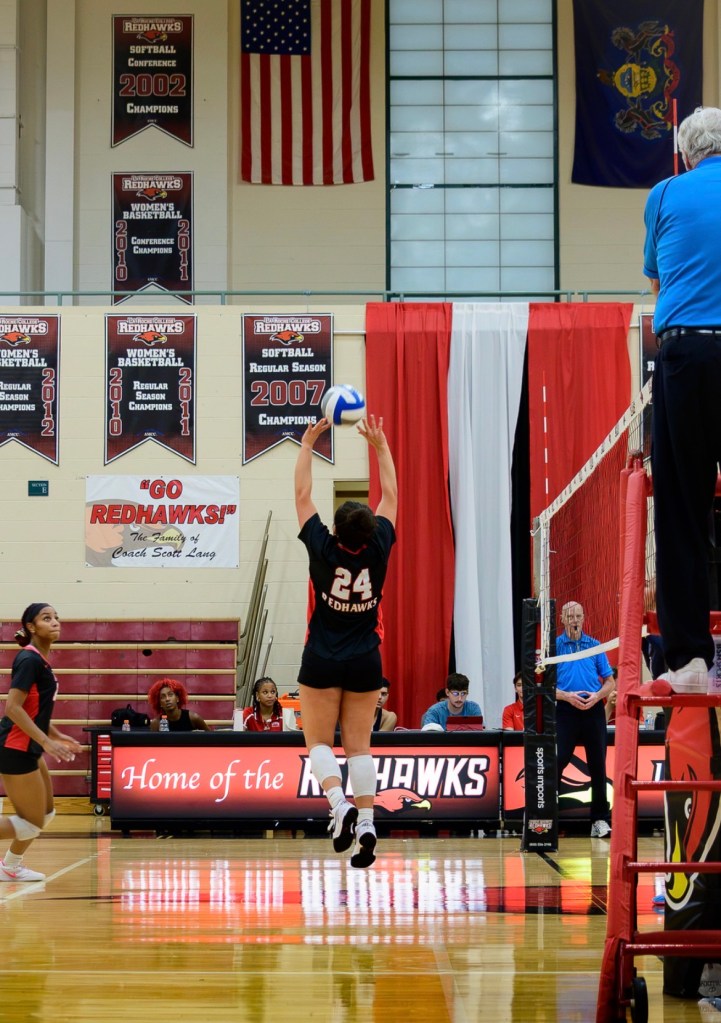
Photo by Kat Strang Photography
La Roche University setter, Estelle Winck, floating over the court to set the ball for her teammate.
“I don’t understand why women, especially athletes, are constantly being shoved with body image advice or suggestions when we already put our bodies through so much day in and day out,” the soccer player said.
“Sometimes I feel as if we are only labeled “good enough” in sports just because of our bodies and the Olympic Games are a great example of what women wear on a global stage,” the volleyball player said.
“The “Just Sports” ad campaign really made a breakthrough in women’s sports, particularly to get women fired up and starting a conversation about what women in sports really is,” the softball player said.
Although the “Just Sports” campaign brought renewed attention to the issue, the fight for equality in women’s sports began much earlier. One of the largest steps towards equality came in 1972 with the passage of Title IX.
This is a federal law that prohibits sex discrimination in education programs that receive federal financial assistance, including the athletic programs.
Before Title IX, college athletics largely emphasized opportunities for men, leaving women with fewer resources and chances to compete. Now, Title IX requires schools to provide equal opportunities for male and female athletes, including the facilities, publicity, equipment, and financial assistance.
As opportunities for women grew, the fight for equality expanded beyond the field to include questions surrounding equal compensation.
U.S. Women’s National Team players Megan Rapinoe and Alex Morgan became prominent voices in another issue of equality on the national stage: equal pay.
In 2019, 28 USWNT players sued the U.S. Soccer Federation for equal pay, resulting in a $24 million settlement three years later. Then months later, U.S. Soccer established equal compensation and World Cup prize money for both the women’s and men’s national teams through 2028.
For the women involved, the fight represented more than the number written on a paycheck. It became part of a larger push for female athletes to have their success, work, and contributions valued at the same level as male athletes.
The battles surrounding Title IX and equal pay helped change what women could achieve and earn in athletics. However, recognition has remained another part of the conversation.
As female athletes continue to gain larger platforms, audiences, and opportunities, questions remain about how their accomplishments and bodies are presented to the public.
The reaction to the “Just Sports” ad campaign has brought that question back into focus. This time, the debate no longer centers on whether women deserve a place on the field or an equal paycheck, but what people see when women in sports are finally given the spotlight.

