
Ghost Students and the Empty Classroom
By Finnleigh Gould
The empty chair next to you is a ghost student, and their name is not Casper, in fact that empty chair is a stolen identity.
Ghost students are scammers after financial aid.
Gregor Thuswaldner, Provost and Dean of Faculty of La Roche University, said, “We discovered that we had two ghost students last semester. Fortunately, we caught them early enough.”
These scammers use stolen or synthetic identities to enroll in college and university courses for the sake of obtaining federal, state, or institutional financial aid. Ghost students primarily seek federal Pell grants that aid low-income applicants, filling up classroom rosters in place of legitimate students.
Casper does not intend to complete his coursework; however, AI chat bots allow the not-so-friendly ghost to respond to assignments long enough to secure funding.
The Department of Education investigated 200 open fraud cases, some of which contributed to $350 million in fraud accumulated over the past five years.
According to Brandon Vinson, La Roche University’s Vice President of Enrollment Management, ghost student fraudulence takes many forms.
“These schemes can include identity theft, fraudulent admission applications, misuse of stolen personal information, attempted financial aid fraud, and enrollment in online or low-engagement courses for the purpose of receiving refund checks. In some cases, ghost students may also use institutional email accounts, student systems, or technology access for broader fraud attempts,” Vinson said.
Ghost students often single out community colleges due to simplified applications, open admission, availability of online courses, and lack of application fees. However, community colleges are not alone.
Vinson explains La Roche’s approach to ghost students as a verification and institutional risk issue. Online learning’s expansion within higher education, and focus on education systems built on access, service, and efficiency complicate the enrollment process alongside fraud prevention.
“Our faculty are our first-line defense against ghost students,” Thuswaldner said.
Students’ engagement with course material is one form of verification confirmed by the Registrar’s Office. “The administration has worked across enrollment, financial aid, student accounts, registrar, and information technology, and academic units to identify suspicious patterns earlier in the process,” Vinson stated.
Real students face the inability to complete required courses on time in addition to inadequate financial aid. New applicants also run the risk of being denied acceptance.
Direct victims of ghost student fraud must prove that their identity was stolen, requiring them to monitor their identities and credit ratings. This makes it difficult to apply for future student loans as well as raises tax and debt concerns.
“They may also experience emotional stress, loss of trust, and the burden of correcting records across multiple agencies or institutions. In higher education, specifically, identity theft can create problems with federal student aid eligibility, academic records, and future enrollment,” Vinson stated. “Even when the fraud is eventually resolved, the victim may spend months dealing with documentation, reports, and institutional or government processes.”
In response to this growing issue, Utah’s Representative, Burgess Owens, pioneered the “No Aid for Ghost Students Act.” The goal: strengthen higher education fraud prevention.
Vinson emphasized that La Roche University prioritizes legitimate students through prevention efforts. These efforts include review of applications, monitoring unusual course registration patterns or financial aid activity, and increasing communication between offices. However, “Institutions will need stronger tools and better cross-campus coordination to detect fraud without creating unnecessary barriers for legitimate students,” Vinson explained.
“Moving forward, the challenge will be building stronger prevention and verification practices while still maintaining the human-centered, student-focused approach that is central to La Roche’s mission.”
Both Thuswaldner and Vinson explained their concern for ghost student activity as AI becomes more sophisticated.
Thuswaldner asked, “With AI advancing, how will AI agents be deployed by scammers? Will we be able to tell ghost students from real students apart? How can AI help us fight against those scammers?”
Sustained by organized fraud networks, colleges and universities across the nation continue to receive fake applications. In 2024, 116 California community colleges identified 1.2 million fake applications; an unrecoverable $11.1 million of financial aid.
Additionally, Vinson elaborated that colleges and universities operate across multiple systems. These systems are not designed to combat this level of fraudulence and financial aid theft.
The U.S. Department of Education continues to investigate this growing fraud, preventing $1 billion in theft in 2025.
Ghost students continue to haunt.
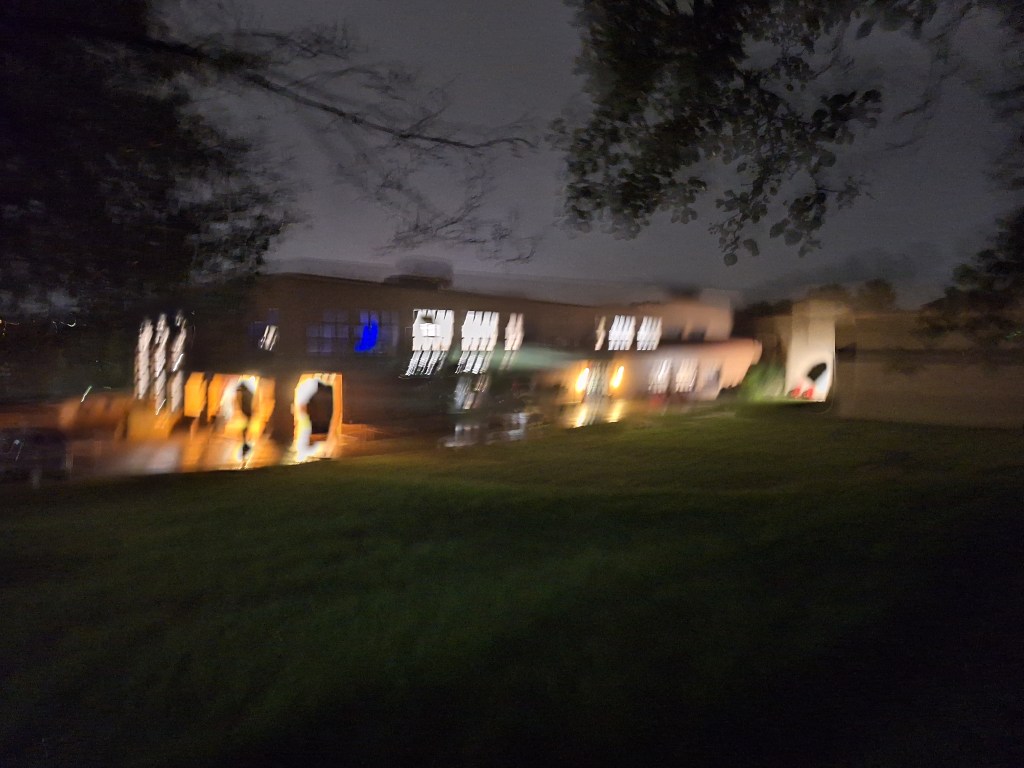
Photo by Finnleigh Gould
La Roche University’s Huber Academic Center; empty rooms and lit windows, glazed by rain and dusk.


Terrific article on an important subject matter, Finnleigh! Super picture, too.
LikeLike