
From Greece to the United States
By Finnleigh Gould
The Nazi invasion of Greece displaced people far and wide, some, across oceans to Rochester, New York; home to a La Roche University student’s heritage.
La Roche University junior political science major, Chae Swierkosz, described his grandparents immigration to the United States.
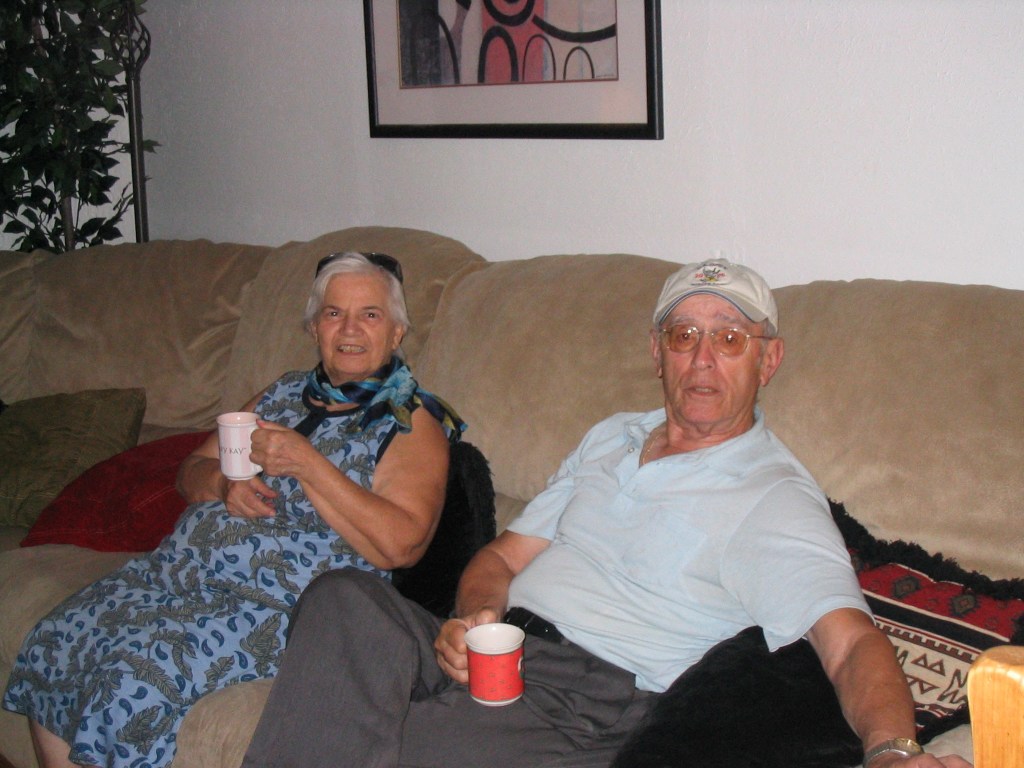
Photo by the Swierkosz family
Chae Swierkosz’s grandparents, Theadora and Constantine “Gus” Vasso on the couch.
“Both of my grandparents on my mothers side are immigrants from Greece, but specifically from the town of Florina,” Swierkosz said. “Both immigrated to the United States due to the Nazi invasion of Greece, but they left at different times.”
Nazi Germany invaded Greece on April 6, 1941, commencing their assault through Yugoslavia and Bulgaria. Their goal; envelop Greek troops occupied on Italy’s Albanian front. Italy declared war on Greece in October 1940.
German troops pincered the Greek troops. The German forces’ strategy was called Operation Marita.
The Allied forces sent 65,532 soldiers in March prior to the German attack. The bulk of the soldiers were from Australia and New Zealand, accompanied by the British Armoured Brigade.
Germany’s troops outnumbered the Allied forces. A German XL Panzer Corp seized Florina, Greece on April 10, 1941.
“My grandma, specifically when you’d ask her about her childhood, was very nonchalant and unphased,” Swierkosz said. “She would tell horrific stories, like how her school exploded during the Nazi invasion, and when you’d react with shock, she’d always have a reaction like, ‘Oh well, it’s whatever.’”
Swierkosz’s grandparents, Theadora and Constantine Vasso, immigrated to the United States through Ellis Island. The Vassos settled in Rochester, New York.
Rochester’s suburbs, specifically The Town of Greece, named in honor of the Greek War of Independence, experienced an industrial boom during World War II. Originally an agricultural area, The Town of Greece became a mecca of wartime production.
Odenbach Shipyard employed over 1,500 people, building tanks, ships, and other wartime vessels.
However, Constantine Vasso, primarily known as Gus, worked as a construction worker. Theadora Vasso was a factory worker and seamstress.
Swierkosz said, “My mom and her family grew up classified as ‘in poverty.’ My grandma was never able to get a formal education past the 3rd grade level…I’ve been taught not to buy what I don’t need unless I’ll use the item until it falls apart, and to try and live more of a small but comfortable lifestyle.”
Despite impoverished circumstances, the Vasso family kept many celebratory traditions alive.
“This isn’t specific to my grandparents, but more so the old Greek relatives that slowly moved to Rochester later on,” Swierkosz said. “If you’ve ever watched the movie ‘My Big Fat Greek Wedding,’ I’d say that 95 percent of the movie is accurate. You’d walk into a family gathering and be swarmed by the old aunties who’d grab your face and squeeze you until your cheeks turned red.”
The old aunties were well fed. Swierkosz explained that Greek food was, and is, a family staple.
Theadora Vasso made spanakopita, which translates to “spinach pie,” for holidays.
A coin was hidden in one of the pieces of spanakopita, granting the person who finds it good luck and a wish. Greek tradition also warrants coins in vasilopita, citrus-flavored cake, during New Year’s celebrations.
Celebration was not limited to New Year’s and food. The Vassos left behind familial artifacts, memories, and old habits.
Constantine Vasso, like The Town of Greece, celebrated Greek independence. Swierkosz explained that he found his grandfather’s tsolias, a historical garb worn for Greek Independence Day celebrations.
Theadora Vasso left behind art.
“My grandma would always be drawing little birds and flowers, which was always so impressive to me,” Swierkosz said. “Her sketches were always repetitive patterns that reminded me of ancient Greek pottery.”
The German invasion of Greece took lives, land, and culture. Julius Ringel, a German major general, enabled illegal excavation of Cretan artifacts, including pottery.
The Nazis looted the land, but not the Vassos’ tongues; they did that on their own.
Swierkosz explained that his grandparents did not pass down the Greek language in order to assimilate to American culture. Although neither Swierkosz, nor his parents speak Greek, his nickname is Chupa, the Greek term for “cute little doll face.”
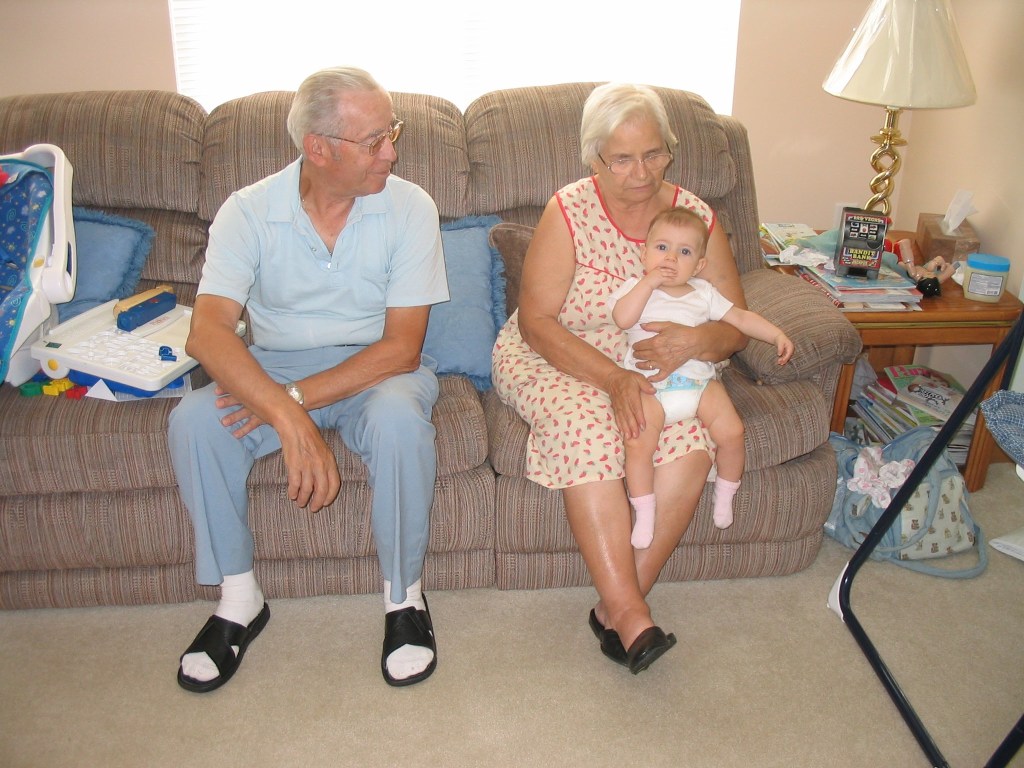
Photo by the Swierkosz family
Theadora and Gus Vasso and their grandchild, Chupa.
“I have always felt regret that I don’t know as much about Greek culture as I wish I did, so sometimes I feel a little bit like a fraud when I tell people I’m half Greek,” Swierkosz said. “I wish I could build a time machine.”
 The Redhawk Post