
Storm-readiness at the Pittsburgh Zoo
By Finnleigh Gould

Photo by Finnleigh Gould
A sleepy-eyed lioness suns herself in her enclosure.
“Duck for cover,” but what about elephant or gorilla for cover?
Katherine Hughes, Director of Marketing and Communications of the Pittsburgh Zoo and Aquarium, conveyed the National Weather Service’s (NWS) recognition of the zoo as StormReady.
Hughes said that the zoo’s prior emergency protocols drew the attention of the National Weather Service’s StormReady program. “StormReady was actually looking for us to submit our plans and protocols, as well as let us let them know what we do here at the zoo,” Hughes said.
The NWS StormReady program was established to develop and assist communities to prepare against extreme weather. The program requires all applicants to establish and maintain an emergency operations center.
“We are now connected with them (NWS) to get information before severe weather might happen,” Hughes said. “We start getting information about two days in advance, and then as we get closer, they give us more updates about what we can expect.”
Hughes explained that the zoo installed a 24-hour warning system, instituting a weather monitoring system via radios and weather spotters to become part of StormReady.
“We experienced a real tornado about a year ago, but about two weeks ago,” Hughes said, “we did a tornado drill. It was a beautiful day like today. Even when nothing is really happening, we practice. Different members of the zoo have different roles to play.”
Hughes’s role, as Director of Marketing and Communications, is to send emails in advance to all staff in preparation for the next day’s weather. Thorough communication allows zoo staff to act quickly and efficiently.
“It’s very much about keeping our people safe on grounds; staff and guests and making sure that we can do what we can to keep animals contained and safe as much as humanly possible,” Hughes said.
Hughes recounted the zoo visitor services team in action. Zoo staff responded to an approaching hail storm with 15 minutes to spare. The staff’s efficiency lends itself to thorough communication; human and animal.
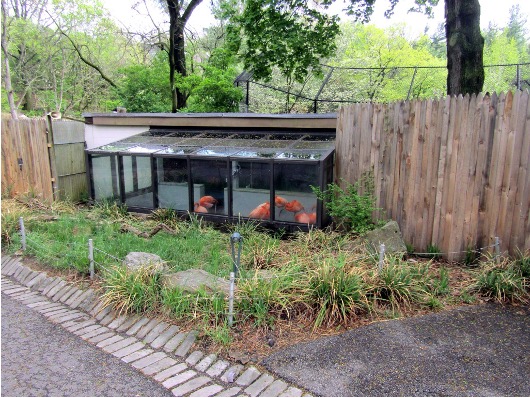
Photo by Finnleigh Gould
The flamingo indoor housing.
There are numerous opportunities for danger when escorting either guests or animals to safety. Hughes said that response time is crucial when getting animals indoors, and that all animals need care and attention. Announcing severe weather gives keepers and zoo staff the necessary information to enrich the zoo experience for both animal and visitor.
Preparation also extends to the zoo’s veterinary services. Hughes confirmed that the zoo has generators available in case of a power outage for animal care.
Hughes said, “They (the animals) all get the kind of care that they need from the keepers that are here, and they’ve got that really great relationship with them.”
Keeper-animal relationships also play a powerful role in maintaining animals’ safety.
“Any animal can be a threat at any time, so you always want to take care,” Hughes said. “The relationship with the keepers is very important for the animals.”

Photo by Madison Dalverny
A zoo handler feeding Hadari, the pygmy hippo.
Any and all information is good information according to Hughes. Knowing the day-to-day weather allows for optimal planning. Hughes said that the zoo’s weather monitoring system enhances seasonal transitions. Staff now have a better idea of when to relocate animals to their winter holding places.
The zoo’s events also benefit from the advanced weather warnings. Hughes gave the example, using one of the zoo’s large fundraiser events, Summer Safari. “We can probably determine, ‘Oh, this is going to be a beautiful day. We can have this table unsheltered out in the sun as opposed to under a tent, because it’s probably going to rain,’” Hughes said.
Even the smallest aspects of the zoo experience are dictated by the weather. However, the zoo is also dictating facility design to withstand severe weather for safety and aesthetics. Hughes explained that the zoo’s grounds team regularly works behind the scenes, analyzing the security of the property’s trees.
“There are absolutely times that our director of horticulture,” Hughes said, “will say, ‘oh we got a tree that’s looking a little funny over here. We should take that down before it becomes a problem.’”
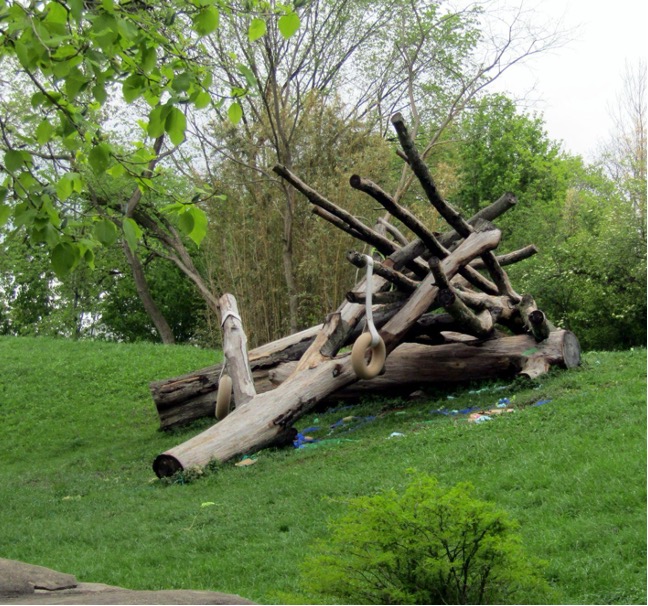
Photo by Finnleigh Gould
A fallen tree reused as a play structure within the gorilla enclosure.
Approximately two years ago, a tree near the gorilla habitat was cut down for safety. The tree was then used as a climbing structure for the gorillas. Hughes stressed that the zoo is taking care of potentially dangerous environments.
The horticulture team not only monitors the status of trees, but the overall grounds. The zoo’s plans for redevelopment cater to storm-readiness and environmentalist attitudes.
Hughes said, “We’re starting our new master plan which is 20 years of redevelopment at the zoo, so we’re going to be working on a variety of things.”
Hughes stated that the zoo has initiated plans to make all buildings sturdy and environmentally mindful. Hughes said that the zoo’s front gates are being rebuilt to account for a lack of public shelter and to provide ease of access.
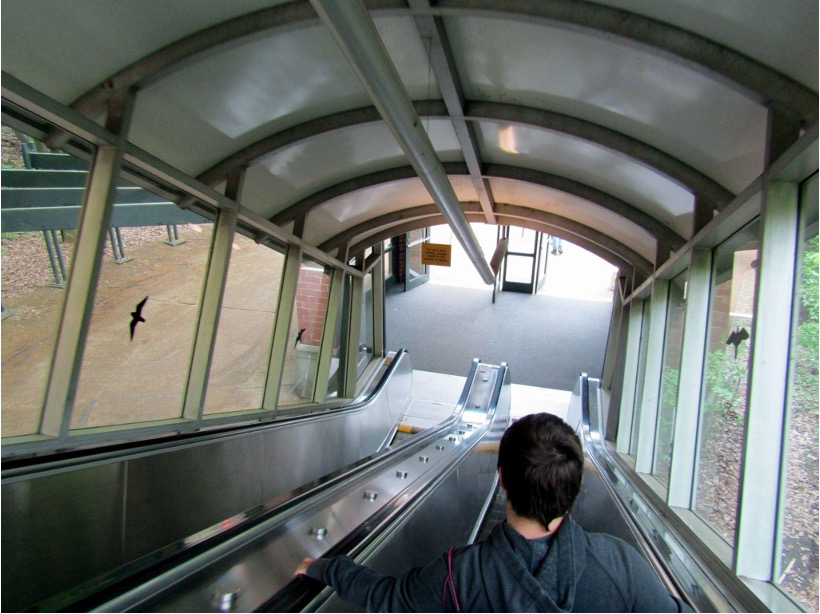
Photo by Finnleigh Gould
La Roche student, Matthew Marrs, going down the Pittsburgh Zoo and Aquarium escalator.
Horticulture has played a crucial role in the master plan. “We have a director of horticulture here at the zoo, planting is definitely part of our plans,” Hughes said, “for any time that we will be building things. So, if we have to take stuff out we’re putting new stuff in.”
The Pittsburgh Zoo and Aquarium is one of four zoos in the nation part of the StormReady program. Hughes was asked why this might be.
“I think it’s just a matter of time. Accredited zoos get messages amongst each other, we’re able to kind of see what others are doing,” Hughes said.
In her final comments, Hughes explained that the zoo networks with animals’ respective regions of origin to keep tabs on the genetic diversity. Hughes said that the zoo’s animals are genetically representative of their wild counterparts.
“We just celebrated our 125th anniversary about two summers ago and there certainly has been change,” Hughes said. “Our mission is to connect people to wildlife. Inspiring our communities to conserve nature for future generations is the mission of the Pittsburgh Zoo.”
The StormReady program further prepared the Pittsburgh Zoo and Aquarium community for all weather possibilities to ensure safety for animals and guests. This program’s benefits extend to other communities like La Roche University, which is not part of StormReady. However, La Roche does use e2campus, an inclement weather alert system.
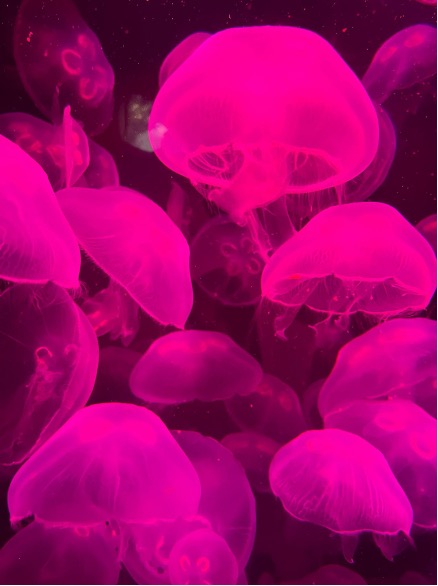
Photo by Bella Garlitz
A picture of moon jellyfish floating in their tank.
 The Redhawk Post