
The Person Behind the Camera
By Finnleigh Gould
Journalism students heard, saw, and felt the presence of guest speaker, Rebecca Droke. The visual storyteller spoke to students about empathy and the qualities of a good photograph.

Photograph by Finnleigh Gould
La Roche University journalism students discussing photo angles during a presentation activity.
“Remember a little bit of what you hear, a little bit of what you see, and all of what you feel,” Droke said.
Clad in a blue sweater vest overtop a purple long sleeve and tawny corduroy pants, Droke gave a presentation centered around her subjects and audience. Droke’s soft-spoken demeanor taught students about the gentler side of visual storytelling.
“Photojournalism, for me, is a way to share how you feel in a moment with the world,” Droke said. “ It’s a way to build connection through empathy and perspective.”
Photograph by Finnleigh Gould
Journalism student, Jackson Decheck, taking a photograph of fellow student, Roger Healy. Students were experimenting with lighting, framing, and unique angles with their photographs.
Droke, who worked for the Pittsburgh Post-Gazette for 13 years, shared her experience photographing the events of the Tree of Life synagogue shooting. Droke and her news staff won the 2019 Pulitzer Prize for breaking news reporting.
Throughout this experience, Droke said that there were moments that she chose not to use photos, and let families cry and mourn their loved ones. Droke said, “There were moments when we went and stood way back and ultimately decided not to use those pictures as a community.”
Being part of a local newspaper requires the photojournalist to have empathy for their community. Droke said she was part of the community and knew when to be sensitive and when to allow some events to go unpublished. Neglecting the humanity and loss of the person on the other side of the lens is unethical.
“I’m going to photograph first and then decide because you can’t decide if you haven’t taken the photos,” Droke said.
Droke acknowledged that her job was and is to take photos, but her concern remains with creating empathetic connections. For the past five years, Droke has worked for wire services, continuing her work with longform visual projects.
The photojournalist’s face lit up as she described some of her projects: A picture of nuns draped in white walking across a beach stayed on the board awhile. One of the nuns seemed to be helping one of her sisters walk. Pointing to that photograph on the classroom board, Droke said, “You couldn’t have had any way of knowing what this piece of work would look like when you first started. You just knew that there was something about these people that compelled you and you stayed with that something long enough for it to show you what it was about.”
“When we’re looking at pictures, we’re looking at story ideas. It’s just something that drew you to them, like these nuns drew me,” Droke said. “I saw them on the beach when they were walking. There was just something really cool about seeing nuns on the beach, it was unique, and then this moment presented itself. I feel really tender to carry that moment that she and her sisters shared as they walked on the beach.”
Droke told students that photos illustrate human stories, lives, and emotions. Some stories are happy and tender, like the nuns on the beach, while others portray the harsher side of reality. Droke transitioned to one her longform project that covered families who had lost loved ones to heroin overdoses.
“I spent a long time following several families and listening to their stories,” Droke said. “I’m looking for different moments and how to show what they’re going through.” She pointed to black and white photos of mourning families.
Droke then transitioned to another project that followed a couple and their daily life taking care of daughters who suffer seizures. Droke said, “They had trust in me, and I trusted them. I was a presence in their life. I think that the times where I really got frustrated were these moments where you hustle in and hustle out.”
The photojournalist said she was often with the family till their bedtime, in which the mother shared a bed with her daughters to monitor their health throughout the night. Droke captured all aspects of their daily life; triumphs and struggles. Some moments captured portrayed the mundane reality of life, others the chaos of parenting four children.
“You’re trying to find every aspect of life,” Droke said, “so it feels like there’s some connection happening.”

Photograph by Finnleigh Gould
Roger Healy, a journalism student, posing for portrait photos for other students.
A student asked how Droke copes with the difficult emotions her stories often confront. Droke explained that one of her most difficult stories followed families who had lost loved ones to suicide.
Droke said, “It was difficult listening to these stories and the pain over and over again. So, that was a lot of you know, taking care of myself, giving myself breaks after I did certain parts of these stories.”
Droke addressed the emotional toll her works sometimes exacts.
Droke addressed the emotional toll her work sometimes exacts. “I think there are moments when I can’t let my own feelings affect how I relate to people. I don’t particularly like never talking about yourself or never sharing anything with people because it just feels like a weird wall,” Droke said.
Ultimately, though often the observer, the photojournalist becomes part of these families’ stories.
These stories just have to be found.
“You start with nothing, aside from ideas and research, requests from an editor or a theoretical shopping list,” Droke said. “All you have is a dream.”

Photograph by Finnleigh Gould
Journalism students standing in a circle with Rebecca Droke. Droke is standing in the upper right corner, wearing boots and tan pants.
Per Droke’s request, Jackson Decheck, a journalism student, read from a slide of the presentation. He read:
“You take your first tentative pictures, hoping there will be something there, and then you find a single photograph that works. It feels like a gift, then you find another one. Slowly, an outline of the story appears, connected by color, movement, emotion, narrative, and once you have an outline, you can fill it in. Some of this is by determination and strategy, but a lot of it is by intuition, trusting and experimenting and feeling your way forward and to be a conceivable thing.”
Droke said that she loved the quote, because it tells us how a story comes about. She said that photojournalism consists mostly of coming up with ideas, and following them through to see where they take you and the story. “You don’t really know what’s going to happen,” Droke said.
Droke, while doing a job for the French press, found herself photographing the July 13, 2024 assassination attempt on President Trump in Butler, Pennsylvania. She described the events of that day, saying that she did not know what had happened but knew she had to do her job.
In modern photojournalism with the institution of social media in the hands of every single person, photojournalists face stiff and rushed deadlines to submit photos before anyone else. Droke said, “I think the challenge of the situation was to get those pictures out. We couldn’t send out pictures, so there was a lot of hustling, to get us out of the complex.”
“Were you scared?” a student asked.
Droke explained that in the moment she was not scared. However, she said she experienced fear when at gunpoint sitting in the grass outside of the complex. She was trying to submit photos of the assassination attempt when a SWAT office approached her.
“That was quite shocking,” Droke said with a smile.
With no more questions to answer, Droke continued to the second portion of her presentation. She showed students examples of her photography to convey the importance of basic photographic skills. “As photographers, we take pictures,” Droke said, “we’re making an intentional decision.”
Droke explained how to compose a photograph. “As photographers, we look through the lens…” Droke held up her hands, looking through them like a camera. Students mimicked her as she continued. Droke explained the rule of thirds, framing, perspective, lines, and lighting to the students.
The rule of thirds creates an active image. When the subject of an image is dead center it can flatten the effect of the photo. To maintain the illusion of motion, a photojournalist uses natural lines to allow the eyes to move across a picture.
Framing and lighting are ways to include creativity and clearly show off the photo’s subject to accurately tell someone’s story. However, out of all of her points, Droke stressed perspective. She asked students to stand up, and take pictures from multiple perspectives of fellow student and volunteer subject, Roger Healy.

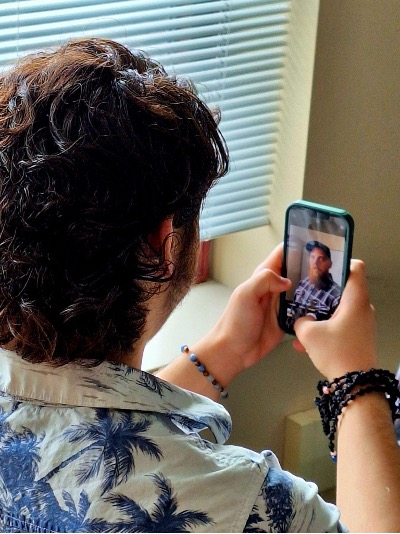
Photograph by Finnliegh Gould and Ava Walters
Journalism students, Finnleigh Gould and Ava Walters, taking a selfie to practice their framing.
“Journalists have an incredible opportunity to go to places where no one else gets to go. You go behind the scenes, and see people’s homes. You have this incredible honor to do that,” Droke said as she walked among buzzing students taking pictures and selfies around the classroom.
Droke presented at La Roche University on Monday, April 8, 2025.
 The Redhawk Post