
Winter Behind the Wheel: How the LRU Community Survives the Snow
By Roger P. Healy

Photo by Bauerstown Volunteer Fire Department
Pittsburgh winters are unpredictable at best. According to the National Weather Service, the Steel City experienced average high and low temperatures four to five degrees below average this past January. February saw an inch-and-a-half above average precipitation and nearly eight inches of snow.
High winds, heavy snowfalls, and wild temperature shifts create hazardous conditions on Pittsburgh’s already crumbling roadways. As local, county, and state crews struggle to keep roads clear, drivers have to prepare and proceed with caution.
Pennsylvania Department of Transportation’s (PennDOT) 2023 state crash statistics report shows that 20percent of auto crashes that year occurred on wet, snowy, or icy roads. Allegheny County was responsible nearly 10percent of the state’s total crashes for the year.
The Redhawk Post surveyed 100 members of the La Roche community between 26 February and 3 March to find out how winter weather affects their driving habits.
Of 100 surveys distributed, 93 respondents completed and returned them. The sample group comprised of 80 students and 13 faculty and staff, 44 male and 49 females aged 18-72.
88 percent of respondents were licensed drivers in either PA or their home state or country. 80 percent of respondents owned or operated a vehicle on and around the La Roche University campus.
Weather affected the social, work, school, and lifestyles of 77 percent of respondents in some way. 57 percent canceled or changed social activities because of weather.
More than a third of respondents reported that they called off or arrived late to work due to weather and road conditions. Females were most likely to miss work, with nearly half reporting that their work was affected opposed to one-quarter of males.

Respondents were slightly less likely to attend class than work. 34.4 percent reported that winter weather affected their ability to attend class. 21 respondents stated that weather had not affected them at all this winter.
Road conditions are a major factor in what people do and what they put off. Driver safety both on and off campus influence rests heavily on the maintenance crews that clear the roads.
The survey asked respondents whether or not they felt that crews created safe driving conditions during and after storms. Most answered yes, with 74.2 percent saying that campus was well-managed, but only 67.7 percent extended that confidence to local municipalities.
La Roche staff member Julie Makuta and Shaler Township resident said, “Shaler crew does a great job! Surrounding areas are just okay.”
Campus was not without complaint either. Multiple comments said that while roads and walkways are cleared, parking lots left something to be desired.
Freshman Taylor Ramsdell shared her concern. “They don’t always plow the student housing parking lots,” she said. “Pulling in from work one night I almost hit someone’s parked car because I slid on ice.”
Alston Boyle, age 23, from Mississippi simply said, “Plow the lots better.”
Respondents rated themselves on how confidently they can drive in the area during rough winter weather on a 1-to-10 scale.
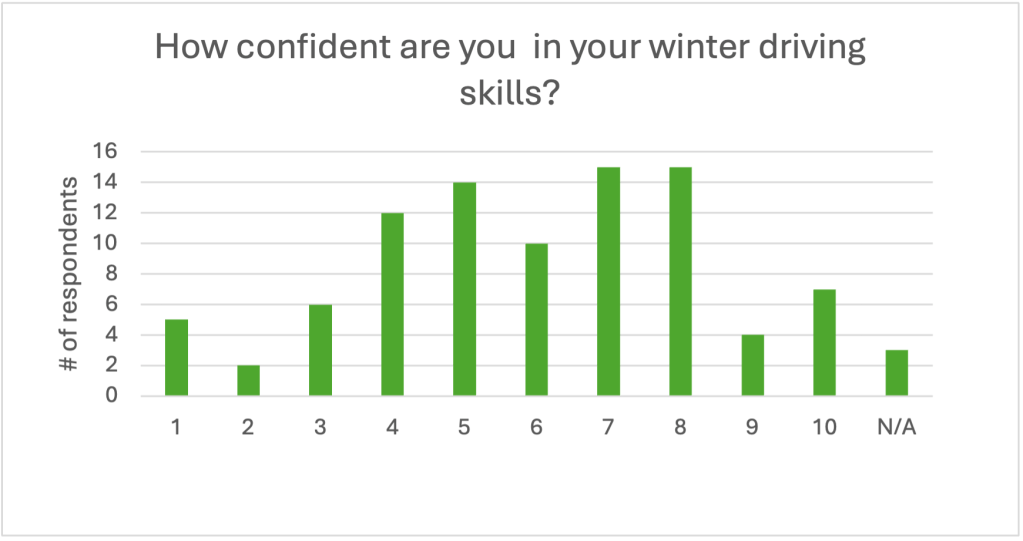
Males claimed to be more confident overall than females. 63.6 percent of males rated their confidence level between 7-10, while 26.5 percent of female respondents rated themselves in that range. Although, according to a 2024 Consumer Affairs report, men are more than twice as likely as women to be involved in a fatal crash.
La Roche staff member Yvonne Hill said that she feels extremely confident behind the wheel. She said, “I have driven in very heavy snow [and] ice. I actually like the challenge of tricky driving conditions.” Hill was one of only seven total to rate herself at 10.
Confidence must often come from experience, as training and education on winter driving is limited. The PennDOT Driver’s Handbook covers wet and icy roads, encouraging drivers to slow down and allow for longer following distances. It also discusses visibility and cornering in various weather conditions.
But how much of this knowledge is being effectively delivered to new drivers?
The survey asked respondents if they had any formal or informal training or advise on winter driving such as formal lessons, instructional videos, or parental advise.
54 percent answered yes, while 43 percent said they had not.

Sydney Antoszyk, a junior from Cranberry, PA, shared a story about when she was learning to drive. “My first winter driving with my permit, I was making a turn and my car slid into my neighbor’s front yard,” she said.
Organizations such as the American Auto Association (AAA) offer advice on keeping a winter emergency-preparedness kit on hand. The organization recommends keeping items like blankets, emergency food, and flashlights.
The survey polled respondents about what items they keep on hand. Options included ice scrapers, blankets, first aid kits, food, water, traction mats, jump starters, and flashlights.
About three-quarters of respondents said that they have an ice scraper, but only seven reported having an emergency food supply and five said they had traction mats. All other responses sat at around 30 percent each. 13 respondents said that they either had none of these items or did not drive at all.
As important as when, where, and how, what people are driving has significant impact on how well their vehicles perform in the snow.
Automotive Columnist Eric Peters with the National Motorists Association discussed vehicles and drive types in a 2010 article. Peters offers pros and cons four-wheel-drive (4×4), front-wheel-drive (FWD), all-wheel-drive (AWD), and rear-wheel-drive (RWD) systems.
Peters suggests that FWD is ideal for on-road driving in snow, followed by AWD systems. The final two questions asked what body style and drive type of vehicles the respondents drive.
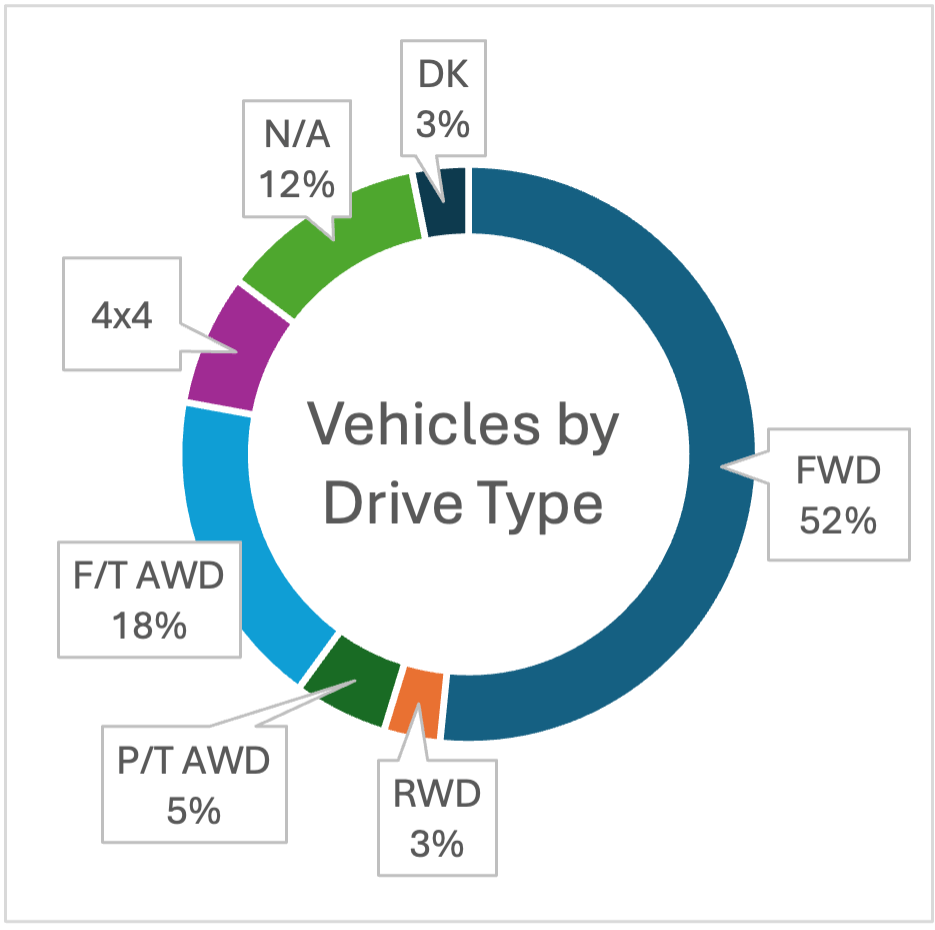
74 percent of respondents said that they drive either a sedan or SUV and over half said that they had a front-wheel drive vehicle. 24 percent said that they have part-time or full-time AWD. Two respondents reported having two different vehicles that they drove regularly, and three were unsure of what drive type they had.
Accidents happen despite our best efforts. Several respondents shared their experiences with severe winter weather on the road. They said that they’ve hit stop signs and guard rails, been stranded in the snow, and even been in vehicle rollovers.
Briana, age 21, of Fort Riley, KS, said that her vehicle once skidded on black ice, hit a snow bank, and burst into flames.
Senior student Daesha Lawrence said that her friend’s car hit ice on Peebles Road her freshman year. The car flipped three times and Daesha broke her knee and femur.
The Federal Emergency Management Agency recommends that drivers keep their vehicles winter ready and clear of snow, and always check weather forecasts before going out. For more information, go to: https://www.fema.gov/blog/10-tips-stay-safe-road-winter
Stay safe Redhawks.
 The Redhawk Post