
Veteran Water Line Repairman Shares Insights on Pittsburgh’s Aging Water Infrastructure
By Roger P. Healy
Pittsburgh area residents are no strangers to cold winters and the effects they have on our infrastructure. Water main breaks contaminate clean water systems and waste thousands of gallons of drinking water.
And repairs are time-consuming and costly.
Day in and day out, public utility workers risk their lives and sacrifice their time to keep our water flowing. They face dangerous traffic, collapsing earth, and extreme temperatures to repair and replace damaged pipes.

Photo by Roger Healy
Donald Werner, age 56, is a retired water line repairman who served his community for over 20 years with Hampton-Shaler Water Authority (HSWA). During his tenure, Werner has repaired countless water breaks, laid new lines, and saved residents’ lives and homes.
Werner met with Redhawk Post staff over drinks in his Shaler home and shared his knowledge, history, and expertise of the area’s drinking water.
Q: When, how, and why did you get into that line of work?
A: “It was about 22 years ago that I was applying for the township. At the time, Shaler Water and Shaler Township were hand-in-hand. If you worked for the township, you’d be subbed out for the water and back and forth. I got my foot in the door reading meters, then I started doing water breaks. Read meters all day, water break all night.
At the time it was exciting, I mean, you’re making a lot of money. But you lay awake at night because you’re always on call. I went weeks without sleeping. I’d know when the phone was gonna ring. You leave and you don’t know if you’re going to be back in a day, two days. It was crazy.”
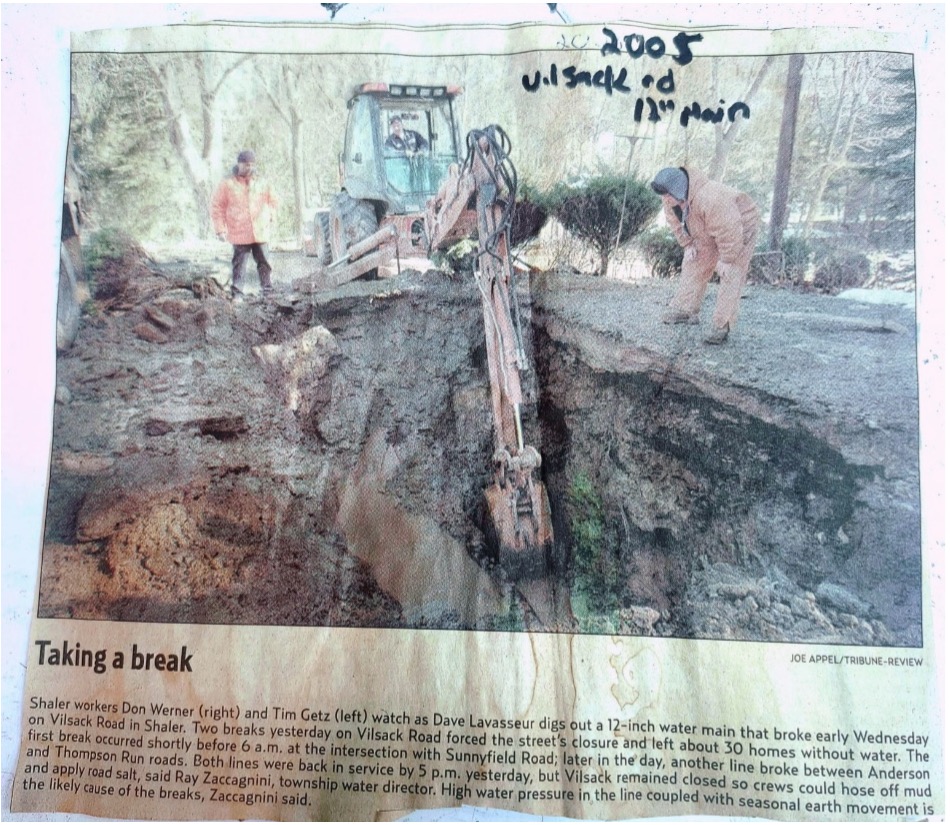
Photo by Don Werner
“I worked in different departments. They called it the outside water, with the water breaks n’nat. Toward the end of my career, I was doing service work too. Installing meters and the house end of it. Going into houses and dealing with people about bills and stuff.”
Q: How old are the water lines that HWSA services and what are they made of?
A: “There’s ductile iron, it’s got like a coating on it like cement on the inside of it. And there’s some transite line, which is asbestos. You might be think ‘Oh! Asbestos!’ you know. But in a water line it’s not a problem. It’s just when you breathe it. But when we have to fix it, we have to cut it, and you breathe it then. That was put in mostly during World War II, when they were trying to conserve on the metal. Lead was done being used in the 1920s. They’re still trying to get rid of all the lead lines.
When we merged with Hampton, we took over Etna and Sharpsburg. Hampton had little parts of different municipalities around them. It’s a big area. Hampton was newer pipes. The old stuff they had, they’d replaced, so they weren’t having water breaks. When we merged, [Hampton’s] guys were tickled pink because they were getting overtime. But then it got old with them, too.”
Q: I read during my research that some older water lines are actually made of wood. Have you ever encountered something like that?
A: I never ran into it myself, but I’ve heard in Sharpsburg they did. When you think wooden pipes, first thing I thought is ‘What’d they do? Drill a hole down the center of a log?’ But they’re planks. They’re put together like a barrel. That was the first pipes. City of Pittsburgh’s probably got some wooden pipes still, too.”
Q: Do breaks typically occur from a single cause or a combination of conditions?
A: “A lot of people want to know what causes the water breaks. There’s a lot of things that can cause a water break. The number one thing is changing temperatures. Once it gets real cold, the earth is still moving just the slightest bit just changing in temperature. Four feet down it may only change a couple of degrees, but it changes and it moves. That causes breaks.
In the summertime, everyone comes home from work and what do they do? They water the flowers, get in the shower… water breaks. Extreme heat in the summer, again the earth moves, stuff like that.
Another thing that causes breaks is big usage at particular times. When the Steelers were in the Super Bowl, I was out at the bar with all the guys from work watching the game. Halftime, everybody went and flushed the toilet. We had six breaks, one of the biggest breaks we ever had. We didn’t come home for days.
Once you have one break, chances are you’re gonna have more because of the fluctuation in pressure. Sometimes we’ll have a break that’s in a low area, like down on Babcock we’ll say. Everyone up here [on the hill] will lose water because it’s rushing out of that break till they get it shut down. Then everybody gets their water back; but the pipes were being pressurized outward. Now they’re being pressurized inward from the earth around them so they actually break inward. One break causes a lot of breaks.
Water freezing in the pipes only happens in the smaller lines, and it’ll never happen if the water’s moving. If you leave a drip going, it won’t freeze. We don’t have a problem with main lines freezing, that’s not an issue.”
Q: How did you deal with pipe bursts in freezing temperatures? Can you talk through what that’s like?
A: “I remember being out when it was so cold that we were pouring creamers into the coffee and it was freezing on the way down. 10 below zero out, you’re fixing a break live, getting blasted in the face with rocks. It’s coming 100 miles-an-hour and ripping your eyes out. Getting out of the ditch and freezing on the way to the truck. Solid, where you can’t move. I mean, frozen stiff. They have to pick you up and put you in the truck. It’s unnatural. Sometimes it would take a day to get a break shut down.”

Photo by KDKA News, 2014
“There’s different kinds of breaks you could have. You could get a blowhole, they called it. And if it’s the right size, you could get a broomstick and whittle it like a spear and try to guide it, as the water’s blasting out, into that hole and then hit it with a hammer. And you cut it off and put a clamp around it. There was quite a few times we had to do that.”
Q: You said previously that you went three straight days out in the cold without rest. Tell me about that experience. Did that happen a lot? How do you prepare for something like that?
A: “In the wintertime it did. You just get up and you go. At work, you would have your main equipment and everything you needed. Usually the first three guys that got there would go out and shut it down. If you were out more than 14 hours or something like that, they’d give you a $10 meal allowance; which you couldn’t use because you couldn’t stop in an emergency.
You get out there and you’re shutting it down and pfft! It breaks six feet away and now you got two breaks. Six hours just turned into 18 hours. Especially on a big break; it’ll cause multiple breaks. They just had one a couple of weeks ago, it caused eight or nine at the same time.
Here’s the deal- you get a break on a 20-inch line. Now, you’ve got streets that tie into the 20-inch line. Then that street ties into another street and it might tie into a 12-inch line, which ties into a 16-inch line. And if this valve here doesn’t work, you’ve gotta turn five other valves because that one don’t work. We’ve been out on a break where we turned over 30 valves trying to shut the break down.
I don’t know how many times we were out there, like, 16 hours, man. You whack the ditch in, you put some cold patch on there. And you’re not even back to our shop when it comes and it comes over the radio ‘You got a huge water break!’ And here it blew three feet away from the vibration from whacking the last one in.”
Q: What did you like about the job?
“There were a lot of thing I loved about the job. I really liked the people. When I was in service there was just so many things that I ran into. I saved three peoples’ lives in different situations, you know, when I was at their houses. I got to help people out quite a lot. I just enjoyed it, I really did.
I went to a house one morning; it had a downward driveway, right? The garage door’s halfway filled up. I’m beating on the door, I go into the house, the mother yells down, ‘He’s in the basement!’ We wake this guy up, walking in water up past here (gestures to waist height). He was in bed, and the bed was basically floating and he was sleeping!
We’ve had people that were totally flooded out four or five times from breaks. Homeowner’s don’t cover it. They call it an act of God. One lady, she lost everything. I think on the fifth time they bought her a new water tank and furnace. So I learned real quick to never buy a house with a downward driveway. But yeah, I got to help out a lot of people and I really enjoyed that.”
Q: What was the most dangerous part about your job?
A: “There were days that I’d go home feeling lucky to be alive. Every single ditch we were in, we were supposed to have a ditch box. Being that it’s a water break, that ditch is ten times more likely to cave in because it’s saturated. It’s the most dangerous ditch you can be in. We never once used a ditch box. We dug right next to telephone poles too, all the way down to the bottom of them, without support. Power lines right there. They’d send you to training, but you never used the damn thing.
If you couldn’t get [a break] shut down, you’d try to fix it live. Which is extremely dangerous. We had water pressures up to 240 pounds. And in those areas of high pressure, you’re doing taps on old pipe because they built a new building there, and I’d have to saddle and tap that pipe. Did it every blow up? No. but if it did, it could kill you right away. We’ve had plastic pipe, the newer plastic, blow up five or six time when they were tapping them.
Guys have gotten hit with traffic standing by the water break. People are just crazy the way they drive when there’s construction site. They don’t listen. You’re flagging and they just come right through the stop. We never lost a co-worker, but some accidents were pretty bad. I’ve seen a saw come out of a guy’s hands and fly out of a ditch and go across a two-lane highway. It could’ve took anybody’s head off. But thank the Lord, nothing ever happened really bad.”
Q: What was the funniest moment you had on the job?
A: “I’ve come to water breaks where there’s a hole in the pipe shooting 300 feet in the air. ‘Is this where you wanted the fountain?’ is what we’d tell people. Or when we turn [the water] back on, ‘We don’t charge extra for the brown water,’ They usually laughed.
There’s a lot of funny people out there that do funny things. We had this lady that had her water disconnected from the street because we were sending spirits, evil spirits and stuff, through the water line into her house. And she didn’t want that anymore, so we disconnected her house from the street. She still lives there today, going on 10 years now.
One Thanksgiving, we were walking down the street looking for a water break. We had these metal detectors that are about four feet long. It’s like a semi-private road with a half-assed pave job, and me and this guy, we’re walking along and all of a sudden I go poof! That thing catches each side of the hole that I broke through. This thing was 20 feet deep and filled with water. I would’ve drowned! That thing saved my life. I though it was cool, that I was getting into the action, but my boss told me, ‘You don’t understand how close you came to dying!”
Q: What was the toughest part of your job?
A: “When it was just Shaler, it was four of us that did every break. I missed every Christmas, every Thanksgiving , every birthday my daughter had. I missed every bit of it. It’s like going in the army, you know. But you know what you gotta do and you just do it.
The shit we’d take from people would be unbelievable. I remember a Christmas Eve, it’s three o’clock in the morning, and I don’t want to be there. I mean, nobody wants to be out there. And I’m shutting down this water break, and this guy sticks his head out the window with shampoo in his hair and yells, ‘Why didn’t you f***ing tell me you’re shutting the water off?’ I said, ‘Why didn’t you tell me there was gonna be a f***ing water break!
They’d come out screaming and yelling at you. But we had other people bringing us food and coffee and stuff.
And flagging… you ever look at the flagger and say, ‘Boy, I’d like to make $40 an hour sitting there and turning that thing?’ It was the worst job in the world. You begged to be in the ditch. It would go by seniority and the low man on the totem pole would be the flagger. Sometimes I was there for six hours with nobody even asking if I had to go to the bathroom or anything. And you freeze no matter what you wear or you burn up no matter what you wear because you’re not moving. It’s a horrible job.”
Q: What do you think about the current condition of our water supply? What problems could the area expect to face in the near future?
A: “Shaler used to win awards for having the best water. The water’s actually brought up from 150 feet below the river. It’s actually drinkable when it comes up. Other places, like the city, Alcosan dumps here (points to spot on table), and 300 yards down the river, they’re taking [water] right off the top to use for drinking water. But that’s the way most places are. City of Pittsburgh Water, back when I was working, they had 90% loss. 90% of the water they treated was lost to either theft or leaks. I rode through the Strip District one morning and I saw probably 15 water breaks going. I’m back probably three weeks later and they’re still going. It could go years before they’d fix a water break. That’s why they had 90% loss. We were at 30, which is extremely good for a system that size.
When Shaler merged with Hampton, they started going out further and further. They have to put more chlorine in it to get it all the way out there and have it still be good. Being close to the plant as we are here, you get up in the morning and you get a shower and it’s like a swimming pool. The chlorine’s so strong. But the actual amount of chlorine you can have in the water and still drink, you wouldn’t believe. The taste has gone down.
We put air relief pits in up in the high areas so that they automatically let the air out and then let air in if there were breaks further down the hill. It really helped out on the amount of breaks. We (HSWA) were lucky and have a really good system.”
 The Redhawk Post