
The Keystone State Welcomes a Keystone Species
By Finnleigh Gould
Grazing beasts of the American wilds were on the verge of extinction; now the International Conservation Center aids the return of genetically pure bison.
Seven-hundred acres lie nestled in the wilderness of Fairhope, Pennsylvania dedicated to wildlife education and conservation. The International Conservation Center, ICC, is an extension of the Pittsburgh Zoo and Aquarium. It functions as a breeding conservation center for various species: African elephants, reindeer, Bactrian camel, and now bison. The ICC also collaborates with organizations like PA Fish and Boat, Game Commission, and Master Naturalists to conserve the land and local species.
Makayla Stoliker, ICC Education Specialist and Elephant Keeper for five years, said the ICC is expecting four bison from Montana as part of a reintroduction program. There will be one male and three females. Construction of their habitat began this past Spring.
The four bison being trailered in are the beginning of the ICC’s breeding herd, meant for the sole purpose of reintroducing mature offspring onto wild preserves.
“This project is important due to the genetically ‘original’ bison becoming threatened due to cross breeding with cattle,” Stoliker said. “Crossbreeding dilutes their genetic diversity and can lead to a loss of important wild traits that allow them to be resilient and survive in the wild.”
According to Stoliker, bison are a “keystone species.” This means that they have a direct impact on the other species within an ecosystem. “For example,” Stoliker said, “they help to shape the landscape through seed dispersal.” The removal of a keystone species, like bison, would remarkably change the ecosystem.
In the 19th century, westward expansion threatened the American bison population with extinction. The National Park Service estimates that the bison’s numbers went from 30 to 60 million strong to under a thousand by 1890. Between 1820 and 1880 “the Great Slaughter” depleted the bison because of demand for their hides. Some estimate the bison were reduced to as little as 300, explained by the National Park Service.
Rachel Oppenheimer, history professor, elaborated on the cultural impact of the bisons’ decline, “Aside from their role in the environment, bison have a cultural importance to native peoples of the Plains region. Their depletion in the 19th century was part of white American settlers’ attempts to assert supremacy over native peoples and Western territory.”
Oppenheimer has been teaching since 2013, having earned her BA from Kenyon College and MA and PhD from Carnegie Mellon University. Her undergraduate thesis focused on the American West.
Due to the bison’s massive disappearance in the 1860s, private citizens captured some of the 2,000-pound animals. The National Park Service says that there were efforts to pass legislation to protect the country’s national mammal, like the 1894 Lacey Act. However, the laws were not well enforced. Bison were still poached within the bounds of Yellowstone National Park despite U.S. Cavalry protection in the 1870s and 80s.
“It was not uncommon for settlers to travel the rails and shoot bison from the train without stopping to collect the meat or the hides,” Oppenheimer said. “The killing was purely for sport and to deprive native people of their resources.” She said she felt a bison reintroduction would be meaningful in acknowledging and reconciling with this painful past.
On the other hand, reintroduction of a keystone species could have harmful environmental results. Joshua Bellin, an animal rights professor for La Roche University, said, “On the whole, I’m skeptical of human intervention in ecological processes.” He also said that human intervention has damaged ecosystems by the introduction of invasive species. Even attempting to reverse a process, like the near extinction of bison, could have unexpected consequences.
To explain his argument, Bellin addressed the reintroduction of wolf populations within the United States. He explained that wolves, as apex predators, affect the entirety of the food chain. Wolves prey on herbivores, like deer, and promote growth of plant life. This, according to Bellin, creates habitats for birds and other small mammals. These small creatures disseminate seeds, impacting fish and insect populations.
Oppenheimer shared Bellin’s concerns, as she has focused on human and wildlife conflict, as well as the cultural consequences. Oppenheimer explained the possibility of bison migrating into human domains and said that this would require resources. She said that if organizations that oversee reintroduction are underfunded, they will not be able to control bison movements. “Recent decades have seen a steady decrease in funding for environmental causes making reintroduction and management a difficult prospect,” Oppenheimer said.
Bellin’s wolf reintroduction example supported Oppenheimer’s concerns. “In this respect, ecosystems with wolves are healthier than ecosystems without. On the other hand, human beings—especially herders and ranchers—have a contentious relationship with wolves,” Bellin said, “and since wolves don’t obey human boundaries, wolf-extermination programs have been revived, particularly by industry-friendly administrations.”
Referencing cultural implications, Oppenheimer expressed concerns towards bison reintroduction, because of the bison’s importance to native peoples. She said that reintroduction will naturally bring up issues due to the reason behind their depletion. “That will likely result in cultural blowback from people who prefer not to be reminded of the aspects of American history that are not unproblematically positive,” Oppenheimer said. She emphasized that history should not be downplayed or avoided, but she fears that organizations reintroducing bison should be prepared for political tension.
In the instances of long-standing reintroduction programs this cultural concern may not be applicable.
Oppenheimer said, “If it can be demonstrated that reintroduction of bison would help rather than hurt the environment, and native peoples were consulted in their reintroduction then yes, it would be morally right to reintroduce them.”
Considering this statement, the Bronx Zoo has been working to reverse the decline of American bison since 1905. According to the Bronx Zoo “Milestones in our Bison History” webpage, the Bronx Zoo has collaborated with Wichita Mountains Wildlife Refuge and Game Preserve in Oklahoma. In 2016, Fort Peck Assiniboine and Sioux tribes sent eight “pure” bison to the Bronx Zoo as part of their program.
This cooperation is crucial to the survival of reintroduction programs, such as the ICC. “Brother Buffalo” is a central part to Indigenous American culture. The National Park Service reports that over sixty 60 tribes are involved to aid the bison’s return.
There are many hopes and concerns for the ICC, “I hope to educate the public on the importance of Bison conservation efforts that many are unaware exist,” Stoliker said. Meanwhile, Bellin quoted Jurassic Park’s Ian Malcom, “‘Your scientists were so preoccupied with whether or not they could, they didn’t stop to think if they should.’”
The concern for environmental and ethical backlash raises many questions. Dr. Bellin raised the following: “Is it ethically correct to reintroduce one species to an ecosystem, even though that might affect other species? Have we taken into consideration the needs of the species we plan to reintroduce, and do we have a plan for what we will do if problems arise?”
Either way, Oppenheimer said, “As a social historian I look at issues related to race, class, and gender. All are in abundance in the American West. Any study of the West and expansion will eventually bring you to the bison. Once you get there, the history of what happened, and the sheer scale of the slaughter is impossible to ignore.”
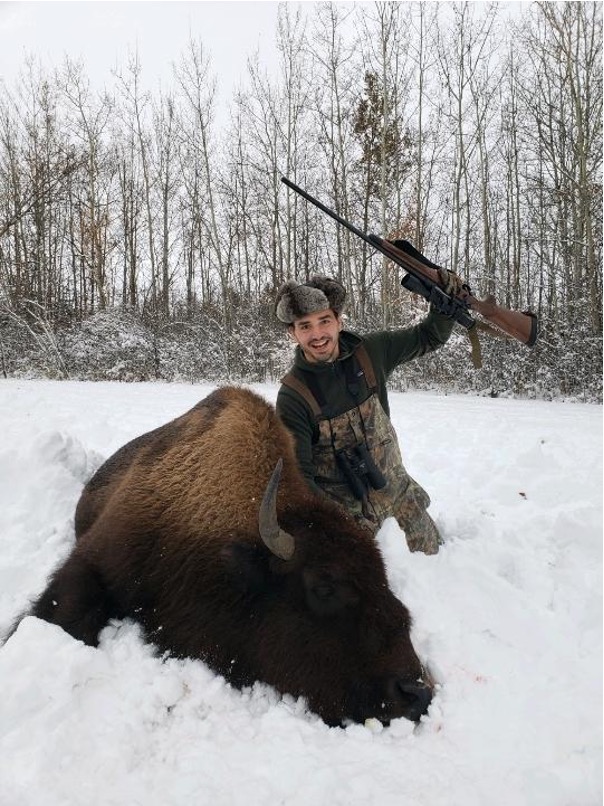
Dr. Brandon Hassett, Ph.D., a La Roche graduate, harvested this bison while on a hunting trip in his adopted home state of Alaska. Brandon, a lieutenant, currently serves as a science officer aboard a U.S. Navy vessel. Brandon is on active duty and is deployed abroad.
 The Redhawk Post