
St. Patrick: More than a Holiday
By Luke Luedy
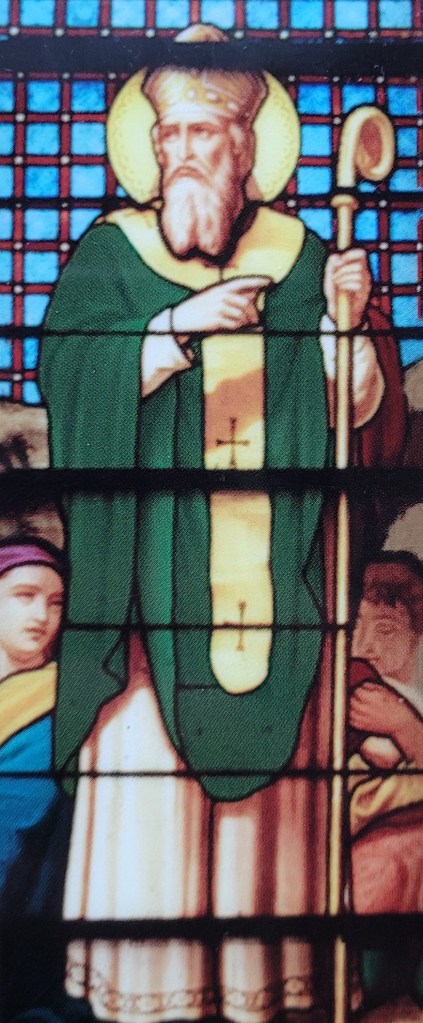
What even is St. Patrick’s Day about, anyways? Do any of us truly know? Millions across the nation celebrate it every year, but do any of them take the time to stop and think what for?
Ireland? Reuben sandwiches? The color green? Leprechauns? Drinking? All the above?
One could easily believe that the holiday falls under the aforementioned categories, with how much large corporations push and advertise them.
But we may be missing the forest for the trees.
St. Patrick’s Day, unsurprisingly, is about Saint Patrick, a Catholic saint. This year, the holiday took place on March 11.
But who was St. Patrick? What was his connection to Ireland? Why is the holiday so widely celebrated in the United States?
This article will shed light on exactly that.
Unluck of the Irish
Historical and religious scholars are unsure of when exactly Patrick was born. They widely agree on the fact that Patrick was born in Britain, while the island was still occupied by the Romans. However, the exact date is unknown, due to its antiquity. Historians believe that Patrick was born either in the late fourth century or early fifth century.
Patrick was born into a comfortable living. His father was a Christian deacon, and his family resided in a villa. He lived his early years happily.
Unfortunately, the luck of the Irish wouldn’t be by Patrick’s side for much longer.
Quite the opposite, in fact, as when Patrick was 14 or 16, a band of Irish pirates captured him during a raiding expedition. This is according to Catholic Online, a website that specializes in relating information of the faith.
The pirates took Patrick and the rest of their loot back to Ireland, which was largely occupied by Druidic pagans at the time. Patrick’s captors then enslaved him, forcing him to become a shepherd.
Patrick remained in Irish captivity for six years, before fleeing to a port and convincing the captain of a ship to take him home. Patrick then returned to Britain, but not before venturing through the wilderness to reach his home.
Yet Patrick felt unfulfilled. A deep gnawing in the depths of his soul.
When he was a slave in Ireland, he was not merely preoccupied with herding sheep. Patrick’s faith in God grew, partially due to the adversity he faced. The future saint himself wrote this in a memoir, simply titled The Confession, that he wrote during his later life.
Once again according to Catholic Online, Patrick wrote the following: “The love of God and his fear grew in me more and more, as did the faith, and my soul was rosed, so that, in a single day, I have said as many as a hundred prayers and in the night, nearly the same.”
In addition, Patrick wrote of prophetic dreams. He once dreamt that “all the children of Ireland from their mothers’ wombs were stretching out their hands,” directly towards him. This is according to Franciscan Media, another website specializing in Catholic information.
With this, Patrick’s goal was clear. After officially becoming an ordained priest around the age of 43, Patrick was given a daunting task: to spread Christianity in Ireland.
Patrick, whose experience of Ireland had been nothing but hardship, imprisonment, and suffering, was now returning to that very place. Not with vengeance or retribution, but with love.
Hitting Close to Home
Around the year 433, according to the Catholic Encyclopedia, Patrick and other Christian missionaries arrived in Ireland. But the conversion of the nation to Christianity wasn’t exactly a walk in the park.
Legends surrounding Patrick’s holy task claim that the saint met with fierce opposition by the paganistic tribes. Some legends even claim that Patrick soon met with a pagan chief who attempted to kill him. Afterwards, the legend states that Patrick converted the man to Christianity.
Generally, Patrick converted the populace through oral teachings and lessons, as paganistic Irish culture was largely influenced by the retelling of legends. This is according to a short biography of Saint Parick on the website for Saint Patrick Academy.
During his speeches to native tribes, Patrick frequently utilized symbols. For example, Catholic Online states that Patrick used shamrocks to explain the Holy Trinity. Thus, one can see how clovers became a prominent staple of the holiday’s modern iteration.
But Patrick was not all talk. Actions speak louder than words, and Patrick took that to heart.
Across Ireland, historians estimate that Patrick founded over three hundred churches. Though many were simple buildings, such as barns, they would provide the bedrock for the Irish Catholic faith. Additionally, Patrick baptized more than 120,000 individuals.
Patrick converted Ireland to Christianity for nearly four decades. Before the sixth century, Patrick died, the exact year being contested among historians. He was buried at the village of Saul, which was also the area where Patrick constructed the first Irish church.
Despite being referred to as a saint, Patrick was never officially canonized by the Catholic Church as one, and still is not to this day. This due to the fact that the Catholic Church did not officially canonize saints until the tenth century.
However, due to the general public’s admiration and appreciation for Patrick, the Catholic Church still refers to him as a saint. This could explain why, in the 17th century, the Catholic Church created a feast day for Patrick.
Red, White, and Blue (and Green)
Saint Patrick has a clear connection to Ireland, but what about the United States? Isn’t Patrick the patron saint of Ireland?
Yes, but the answer goes deeper than one would expect.
St. Patrick’s Day is one of the most widely celebrated holidays in the nation. Major cities such as New York City or Philadelphia hold grand parades in honor of the holiday. Chicago even goes a step further and dyes the city river green.
But despite all the festivities and celebrations, St. Patrick’s Day is not an official United States holiday.
The reason for the holiday’s wide recognition could lie in the nation’s demographics.
From 1845 to 1852, a potato blight ravished Ireland, a period of time known as the Great Famine. During this period, roughly two million Irish emigrated to the United States, according to the National Museum of Ireland.
While two million citizens seem like a small number overall, the Irish-American population would steadily increase. In 2021, the U.S Census Bureau reported that 9.5% of the population, or 31.5 million people, were of Irish descent.
For reference, Ireland’s population in 2021 was five million. The United States has more of Irish descent than actual Irish citizens in Ireland! That could undoubtedly explain the saint’s broad appeal across the United States.
Making a Change
While Patrick’s life took place over a thousand years ago, his experiences can still be of value to us.
We live in an era where it has never been so easy to feel disliked. With the power of mediums such as the Internet or social media, one can find people or organizations that abhor your beliefs.
And while most of us certainly don’t have it as bad as being enslaved for years, those slights against our character add up.
Yet Patrick did not simply, say, make an even meaner post in reply.
When push came to shove, Patrick displayed the utmost mercy and kindness to his enemies. And the results of such benevolence were truly world changing. It’s not so simple to spread a religion across a nation in a few decades.
Patrick, however, was not a doormat, either. The work that he and the other missionaries did was not done through belief and ideals alone. They were able to convert the people of Ireland to Christianity, due in part, through their hard work and dedication.
Ultimately, though one may feel that the world itself is against them, that they can make no change whatsoever, Saint Patrick proves it’s still possible.
And the best part is, the luck of the Irish is only optional!
 The Redhawk Post