
Returning to an Old “New” Place
By Joshua Vedis
You’ve just spent the majority of your life in uniform, with men and women from across all walks of life. You’ve immersed yourself in a culture far separated from anything you could imagine before joining the military. After countless hours, days, and years of your life in the military culture and creating bonds so strong that they seem more like family than even your biological ones, you separate. You leave and find yourself in a place that was once so familiar, somewhere you called home. Yet, after so much time away, in a culture that changes you fundamentally, you find yourself alone and uneasy in vague familiarity.
One concern that troubles veterans is adjusting and dealing with the sudden changes to their lives after they finish their military service. They find themselves suddenly removed from a lifestyle, friends, and family they’ve dedicated themselves to. The magnitude of this feeling only intensifies as one’s military service lengthens and the bonds they’ve created deepen.
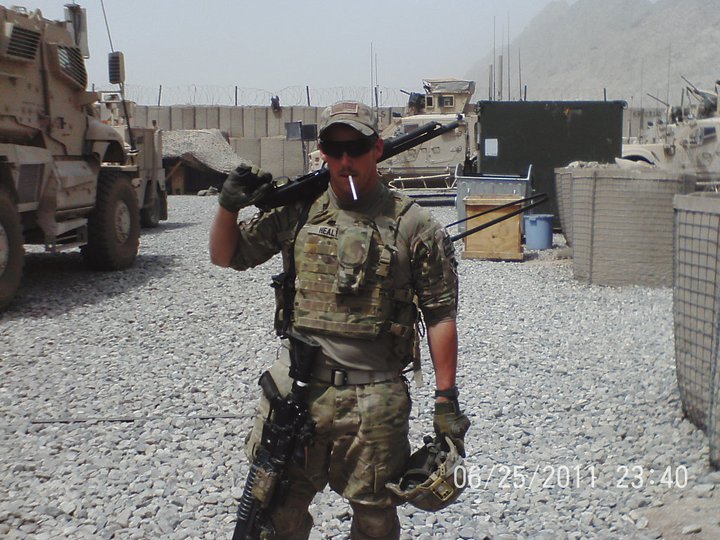
Roger Healy is a sixteen-year Army combat veteran who medically retired in 2018. He is thirty-nine years old and has a wife and two children. Spending so much time in the Army, Roger, like many other veterans, has a great interest in meeting other veterans he can connect with. Among other veterans currently enrolled at La Roche, Roger is the most outgoing and vocal when it comes to matters of the Veteran Community and building a place for veterans at La Roche.
Roger agreed to an interview where he would detail some of his experiences after he left the Army and how he adjusted to the changes in his personal life after leaving the Army.
The first question asked Roger how his military service and lifestyle had changed his perspective on the world and how he dealt with problems outside of the Army.
Roger explained that his experiences in the Army had a significant impact on how he views life outside of it. How the Army let him see a larger portion of the world than most people normally get to experience. However, this chance to see other parts of the world wasn’t exclusive to the best regions, where there was no conflict.
Roger stated, “It’s hard to keep a positive outlook after seeing so much damage, but I developed appreciations of other cultures and realized that governments and world leaders rage while the rest of us are just trying to lead a decent life.”
One significant change to Roger’s perception of the world is that he is more vigilant of those around him, keeping a watchful eye for any possible dangers that may occur, and keeping himself ready to react swiftly. “I often take action and react more quickly to trouble or challenges,” he said.
Everyone has a reason for why they decided to join the military. When Roger was asked if he could explain why he decided to join the Army, he explained that he had several reasons. As a child, he would play soldier. He said, “It was a childhood dream,”.
He had strong convictions to develop himself and do something he thought would matter. Then there was the 9/11 terrorist attack on the Twin Towers. Roger was old enough not only to remember this happening but to join the military soon after.
Roger explained that his final reason for joining was due to the people he called friends at the time. He detailed how he found his friends getting involved with drugs and wanted to distance himself from that kind of environment before it could affect him.
The next question asked was if Roger ever thought he would have left the Army before his medical discharge. He replied saying, “I never planned to, but I always thought that I might have to.” Like any other human, Roger has strong beliefs in what he believes is right and wrong. What should or shouldn’t be done in any given situation.
When Roger was planning his miliary career, he knew he would face hardships that he’d personally have to overcome but had no intention of going against his beliefs of right and wrong. He said, “I kept in mind that one day there may be a situation that I couldn’t serve in.”
There are a significant number of barriers veterans must face when they leave the military and transition to civilian life. The interviewer asked Roger if he could describe some of the major barriers he faced during his transition.
Roger replied saying, “People. Everyone’s so different on the outside. There’s a lot of weirdness and feelings that you just don’t deal with in the infantry. The pace and work ethic is often very different.”
Roger explained that there is a particular efficiency that comes with being in the Army. When people are told to do something, there is a distinct reaction to get it done quickly and done well. There’s little to any time for people to be lethargic and take more time than explicitly necessary to complete any particular task.
When Roger compared how things are done in the Army to civilian work, he explained that many of his previous coworkers found him overbearing or aggressive. That he pushed too hard. Leading him to quit his jobs in search of something else. Roger understands that civilian and military workstyles are vastly different, but still has a hope that he’ll find somewhere he’ll fit in. He continued, saying, “I just haven’t found my right place in the people world yet.”
A significant barrier Roger had to face after leaving the Army was the overwhelming feeling of loneliness. There is an unmistakable bond that military members share, how they speak and act with one another; and it’s near impossible to find in the civilian world.
Roger said, “It’s hard being so far removed from the lifestyle and culture. I feel alone, a lot. Everyone who wasn’t there became unrelatable, at least on a deep level.” He continued, “Often even my own family.”
He explained how he has to constantly think about what he’s going to say, and how he has to say it to people. In the military, there are far fewer social restrictions on how explicit, and even gruesome, jokes and general banter can be with one another. They can be extremely self-deprecating, aggressive, obscene, and generally eccentric. However, once removed from the military lifestyle and culture, these kinds of jokes and banter can cause distress, confusion, and distrust.
The interviewer asked Roger what the greatest obstacle he had to overcome outside of the military was.
He replied, saying, “Learning to live with my physical limitations. I was so strong, active, energetic, and capable before. Now it’s painful to replace a light bulb.” He continued, “I’ve learned to cope through the physical and mental pain therapy, but I still have days when I just can’t do anything or get depressed because of it.”
Returning to civilian life after the military carries many difficulties with the transition. The interviewer asked Roger to explain some of the most difficult parts of this transition that he’d faced.
Roger said, “The transition period was really hard for me. I was forced to leave when I didn’t want to, and that hurt.”
While Roger was staying near Fort Stewart for two years after his discharge, he was still in contact with many of his Army friends. However, a gap began to grow between them rapidly as time moved forward. He said, “They were still training, preparing, and deploying while I was watching civilians move stuff with a forklift.”
He continued, saying, “The pace of life in general slowed down like crazy. Soldiers are always busy. There’s always something that needs to be done. I would wander around my house like a shambling ghost, not knowing what to do with myself. There was never enough time before, suddenly, all I had was time. It was maddening.”
Roger explained how his transition put him through mental and physical difficulty, which led to him questioning everything he had done. Even with this strain, however, the love and support of his wife and family were there to help him through those difficult times. He pointed out that he still hasn’t fully adjusted to life outside of the Army, he’s still getting used to hearing his first name when people call for him, but his outlook has become more positive since the initial change.
The next question asked if Roger were speaking to a civilian about military life, how would he describe the military lifestyle compared to civilian life?
Roger said, “The Army keeps you young at heart. It’s a wilder life with high demand. Everything is so much more regimented and controlled, and people are there for more than a paycheck.”
He explained how, similar to himself, the people he was with wanted to do something more with their lives than focus solely on making as much money as they could. They wanted to better themselves and do something they thought was important.
Roger continued, saying, “It’s like living in another universe. All your friends are soldiers, all your neighbors are soldiers, and everyone is doing the same stuff.” He explained how all the children around were military kids, and that their typical interactions would be based around the places they’ve lived, bases they were stationed on, what country they were born in, and how long they thought it would be before they would move again.
Roger said, “My daughter transferred schools 10 times from kindergarten to graduation.”
The interviewer asked if Roger could explain if there were any problems outside of the Army that he hasn’t been able to adapt to or had significant difficulty adjusting to.
Roger replied saying, “Working with the general public.” He continued, “I did okay dealing with skilled tradesmen, but horrible with soft-skill or office people and customers. As a project manager for a remodeling company, I had to deal with doctors and lawyers and accountants as clients. I got way too irritable way too quickly and just couldn’t keep answering their questions and trying to get them to choose their paint colors.”
He expressed that his last job working with contractors, who did steam fitting and HVAC worked as a better fit for him. Some of them even being veterans. He explained that they were easier to work with because they knew exactly what they were talking about and what needed to be done to finish a job. That, even though they were “a tougher crowd,” they were smart, technical, and didn’t waste time. Which felt like a good fit for him.
Something the people outside of the military rarely think about is the greater reach that military life has on others’ lives. Specifically, the lives of immediate family.
The interviewer asked if Roger had a wife and kids before he joined the Army, how they adapted to such a change, and if their transition back to civilian life as strained as his own.
Roger replied, saying, “I was already in the Guard when I met my wife, so the military was present beforehand, but not in a major way. The major changes didn’t come until I went Active Duty in ’08. My daughter was four years old, and my wife was pregnant with my son, so going in wasn’t too hard for that young of a child and my son was born into it. My wife had some difficulty in adjusting. She lost touch with all her friends, pulled away from her family, and didn’t understand the full scope of my duty. But she’s a dedicated wife and mother, and always gave us her best.”
He continued, saying, “My daughter got used to all the moves and the crazy schedule pretty quickly. She grew into the lifestyle well, and still never wants to stay in any place too long. Most of our moving was done by the time my son started school. I think that when it all really starts to matter to kids. He started school in Georgia and was there for six years before we moved back to Pittsburgh. It was really tough on him because he was settled in that community.”
Roger continued to explain that there was a great deal of stress during his family’s transition that he felt shameful about. During the transition he had the most difficulty adjusting and fell into a downward spiral because of it, causing stress for his family. He said that “no one really knew what was going to happen, and that uncertainty weighed badly on them.
One of the biggest questions many prior service members ask themselves is whether or not their military career had made any difference in the larger scale of things. The interviewer asked Roger if he’d ever thought of it, and if he thought that his time in the Army made any difference.
Roger said, “I have thought of it many times. Sometimes the impact I made is all I can think about.” He continued, “I stopped caring about the big picture about a month into my Afghanistan deployment. The important part is the differences I made on the ground. We did a lot of good in Haiti. Fed some kids, saved some lives in the chaos. We protected people as we gave them the necessary things to keep them alive. We brought security and infrastructure to villages in the ‘Stan. Cleared IED’s (Improvised Explosive Devises) off the roads so they could live their lives without fear.”
Roger went on to explain how he helped to train the Chadian army so they could combat terrorism in Central Africa. How the impact they made was so great that Roger was even offered land of his own to live alongside them, but that he had to turn it down because of his service to the Army. Roger said, “They wanted me to join them fighting Boko Haram on Chad’s borders. I’d have done it in a heartbeat, but the DOD (Department of Defense) disagreed with the idea.”
Roger explained that the most important difference he made during his time in the Army, was that he was able to bring everyone he was in charge of back home alive. He said, “I helped build strong men and future leaders. I helped build strong units that were capable of surviving anything thrown at us. I taught, mentored, advised, counseled, and occasionally inspired my peers and subordinates to grow in every aspect of their lives.”
While Roger is content with the small differences he made, he doesn’t think that he made any changes that would make a difference on a national or global scale, or even a political one. He expressed that making those kinds of changes don’t really matter to him and that the people in charge, at the highest level of powers will continue to do what they do with little regard to the people on the ground.
The final question the interviewer asked Roger was if given the chance, would he want to return to the Army and military lifestyle after experiencing life outside of the military.
Roger said “If it were the same Army it was from ’02 to 2014, yeah. I’m good where I’m at otherwise.”
 The Redhawk Post