
The Views of Veterans at La Roche
By Joshua Vedis
Imagine a service member out on patrol in the middle of the night in a foreign land. They’ve gone through relentless and excruciating training to hone their skills to be as sharp as the edge of obsidian.
Checking their surroundings with keen eyes to determine the difference between a bush blowing in the wind and an enemy situated on the other side. The multitude of ways they can respond if the enemy does show themselves.
All this information is so deeply embedded into the subconscious of each service member that they can react to any situation they find themselves in, in mere moments. The only solace coming from the presence of the others in their squad.
Connections that run so deep from years of time together, training relentlessly to overcome any obstacles, each one of them would put their life on the line to protect the other without hesitation.
Now they find themself back home, enrolled in college, and separated from the people who became their family. Many students present on a college campus find themselves there directly after finishing high school.
Service members on the other hand dedicate anywhere from four to over 20 years of their lives in the military. By the time they arrive at college, the age difference between them and their fellow students is substantial enough that it can create an invisible social barrier that leaves service members feeling isolated in another foreign environment.
Service members find it difficult to connect with non-service members, as the difference in mentality is too different to create any kind of relationship with the average college goer.
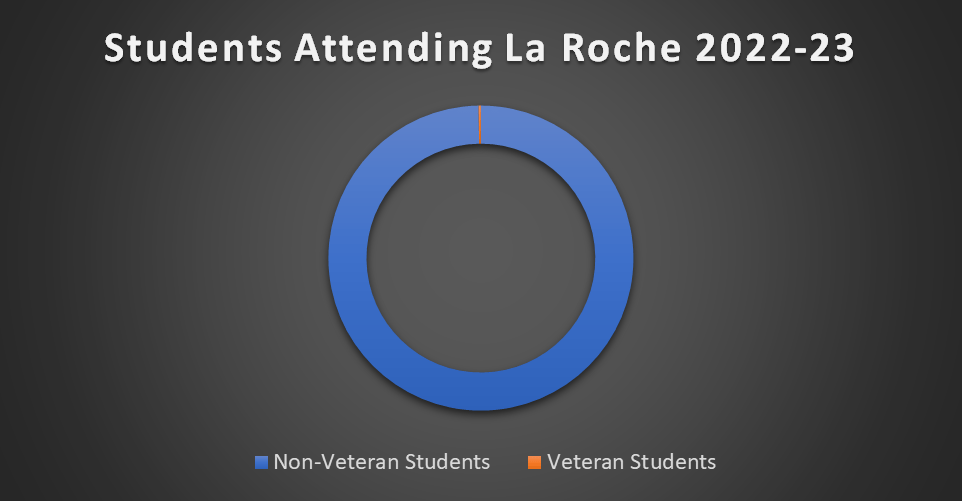
This September, a survey was conducted at La Roche University for the veteran student community to gauge how positive their experience has been while attending LRU. Five veterans completed the survey.
The survey posed the questions of how well veteran students would rate their interactions with non-veteran students and faculty from very good to very poor. The results of this question found that the veteran student population unanimously found interacting with non-veteran students to be average. While their interactions with faculty were unanimously very good.
The survey indicates that interactions between veteran students and non-veteran students were unremarkable, while faculty interaction was above and beyond the veteran students’ expectations.
Multi-branch veteran David Reese explained in an interview that his interactions with the faculty in his field of study were exceptionally helpful and understanding to his situation when he was faced with any problems during his time at La Roche.
The survey asked veterans if they were taking advantage of the VA benefits to attend La Roche. Every veteran stated that they were using the benefits provided by the VA to assist in paying for their schooling at La Roche.
Along with the benefits provided by the VA, the survey asked veterans if they were aware of the benefits that La Roche provides veterans. Every veteran was aware that La Roche is a part of the Yellow Ribbon Program and the benefits such schools provide.
Alex, a Marine Corps veteran said, “I chose La Roche specifically because it was part of this program.” He continued to explain that he never cared about the prestige of a school. He was more focused on whether it was a good fit for him as a veteran.
An issue that many veterans deal with when attempting to use their benefits is the Veterans Affairs department. The survey asked veterans to rate their experience with La Roche’s VA official on a scale of one to ten. Four of the five surveyed veterans rated their experience with La Roche’s VA official as a nine or above.
The survey asked whether the veteran students commuted to La Roche for their classes or lived on campus. The members of the veteran community answered as a whole that they commuted.
While there is only a handful of military veterans attending La Roche University, their military backgrounds are greatly diverse and distinct from one another. Beyond this diversity, however, one thing remains constant.
There is a uniquely intrinsic bond between veterans from all branches. Members of any branch find a near immediate bond of one kind or another when interacting with other military veterans. Regardless of age difference, service length, or military background.
The survey asked whether veteran students were interested in attending veteran specific events at La Roche. This is the only question where the La Roche veteran surveyors were divided. Of the five surveyed veterans, two answered that they were interested in veteran events.
Of the veterans who answered against the proposal, one of the surveyors, who asked to remain anonymous for his statement, said “I’m not against meeting up with other vets, but I’d prefer to fly under the radar. I’ve no interest in being restricted by La Roche’s rules for how I spend my time. I’ve dealt with enough of that in the military.”
As the final question, the survey asked veterans if they’d refer other veterans to attend La Roche. The surveyed veterans answered with a resounding yes. The veterans expressed a great admiration for how accommodating La Roche and its staff is when it comes to disabilities and military duties that make attending classes difficult.
Bourdeau, a member of the Air Force Reserve, said, “La Roche is a great school that made me feel welcome from the start and they showed their commitment to veterans.”
Being in the military demands that a person think of themselves not as an individual, but as a part of a larger entity. This environment creates an extraordinarily strong bond between members. However, individuality is stripped away in the greater picture.
The surveyed veterans expressed that it is because La Roche is on the smaller side of colleges that they regard it so well. The smaller class sizes allow for person-to-person interaction between students and faculty. It’s the kind of environment they appreciate.
 The Redhawk Post
Vedis, this is a super interesting read.
LikeLike
Love this 👍
LikeLike
I enjoyed your alternative lead. Great way to lead into the main point of your article.
LikeLike
Edge of obsidian? NICE! Really enjoyed your article, Vedis!
LikeLike